






Metaverse refers to a virtual world where users can engage in immersive activities online. Web 3.0 technology signifies the progression of the Internet towards a more decentralized, user-centric ecosystem. The boundaries of what we can accomplish online are continuously expanding due to developments in Web 3.0 technologies & the Metaverse.
When it comes to exploring and solving real-life problems using Augmented Reality, Metaverse Development, Blockchain technology, and Virtual Reality, we at axiusSoftware lead by example. We are always excited to front major transformations in the field of Metaverse and Web 3.0 technologies.
In this blog, we will examine the connection between Web 3.0 and the Metaverse while outlining their advantages and determining how these two ideas are impacting the world as we know it.
Let’s Dive Right In!
Understanding Web 3.0
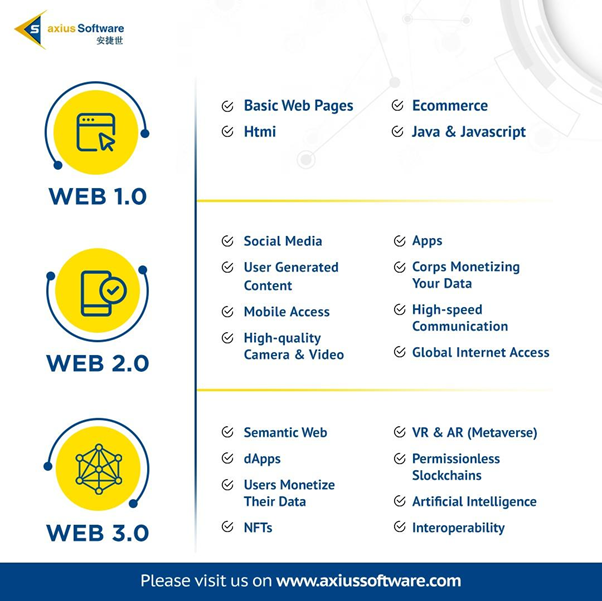
Web 3.0 incorporates technologies such as blockchain, decentralized networks, and smart contracts. These components enable secure, transparent, automated transactions online without the need for intermediaries. In contrast to Web 2.0, which introduced interactive social media components, Web 3.0 technologies are more user-centric.
Prime Example of Web 3.0 Technologies in Action: The Education Sector
Web 3.0 technologies are regarded as highly impactful and transformative in the education sector. The following four are the most important contributions of Web 3.0 technologies in education.
- Web 3.0 enables educators to take learners to a virtual environment where they can learn more.
- Learners can obtain information easily owing to decentralized sharing systems.
- Educators can automate the checking process and create engaging materials.
- Web 3.0 technologies in education, can be an alternative to the conventional passive schooling system.
Defining Metaverse
The term “metaverse” describes a virtual world where users can engage in meaningful and immersive interactions with one another and their surroundings. To produce realistic and immersive online experiences, the Metaverse integrates components of virtual reality (VR), augmented reality (AR), and other cutting-edge technology.
Virtual worlds like Second Life and online games like Fortnite and Minecraft are some topical examples of precursors to the concept of Metaverse. Users can explore, create, and engage with others on these virtual platforms.
As the Metaverse landscape expands, social media sites like Facebook’s Horizon Workrooms and VRChat are adding to it by providing areas for communication and teamwork online.
Web 3.0 and Metaverse: A Realm of Digital Possibilities
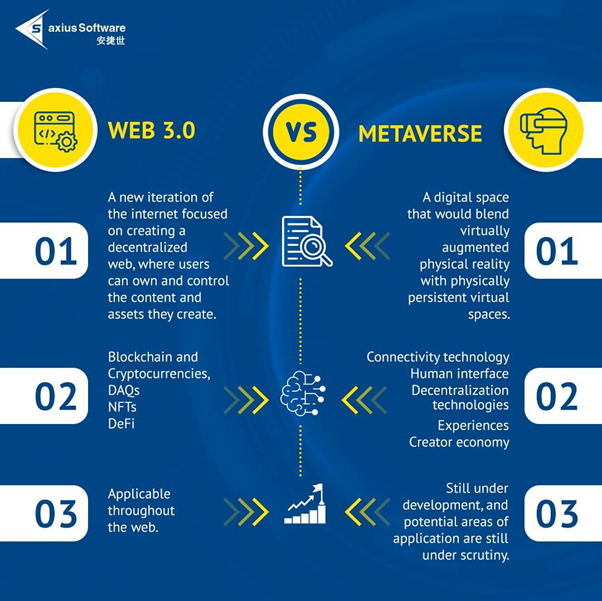
The Metaverse and Web 3.0 are based on similar ideas and technological advancements that complement one another. The idea of a user-driven and open Metaverse is compatible with Web 3.0’s decentralized structure. The Metaverse can improve its user ownership, security, and transparency issues further, by utilizing blockchain technology from Web 3.0.
Why You Should Incorporate Web 3.0 and Metaverse
There are various advantages of incorporating Web 3.0 into the Metaverse.
- With the capacity to safely buy, sell, and trade digital goods, users can be the sole owners of their virtual possessions.
- Users will be able to shift their virtual assets and browse the Metaverse with ease thanks to the interoperability between various virtual worlds and platforms.
- The idea of digital scarcity of items, made possible by blockchain technology, can generate demand for unique and priceless virtual items in the Metaverse.
Build a Future Using Web 3.0 and Metaverse
Both Web 3.0 technologies & Metaverse require handling enormous amounts of data and serving millions of users at once, making scalability a major challenge.
For Web 3.0 capabilities to be successfully incorporated into the Metaverse, there must be broad user adoption and education. Especially if we are considering sectors such as education, then web 3.0 technologies for education are something that would require hands-on training.
We at axiusSoftware, believe that the disruptive inventions of the Metaverse and Web 3.0 technologies can help create interactive visual solutions for our clients. From AR Applications to Metaverse Development, we adapt to new advancements swiftly. For service-related inquiries, visit our website, www.axiussoftware.com, today!